Voluntary Respirator Use: What Employers Still Owe Employees
When respirator use isn't required by OSHA but employees choose to wear one, employers still have obligations. Here's what Appendix D requires and how dust masks differ from elastomeric respirators.
Not Every Respirator Triggers a Full Program
When employees choose to wear respirators on their own — even though exposure levels don't require it — the employer still has obligations. Those obligations differ depending on the type of respirator.
Understanding the distinction between required and voluntary use is critical. Getting it wrong can mean running a full respiratory protection program when you don't need one — or skipping required steps when you do.
When Is Respirator Use "Voluntary"?
Respirator use is voluntary when the employer has determined that:
1. Employees are not exposed to harmful levels of airborne contaminants (i.e., exposures are below OSHA permissible exposure limits).
2. The use of a respirator will not itself create a hazard (e.g., heat stress, impaired vision, or restricted movement).
If either condition is not met, the use is required — not voluntary — and the full respiratory protection program under 29 CFR 1910.134 applies.
Employer Obligations: Dust Masks vs. Everything Else
Even for voluntary use, the employer must take specific steps — but those steps depend on the type of respirator.
Filtering Facepiece Respirators (Dust Masks)
For employees voluntarily wearing N95s or other filtering facepiece respirators:
* Provide OSHA Appendix D to the user
* Ensure only NIOSH-approved respirators are used
* No medical evaluation required
* No written program required
All Other Respirators (Elastomeric, PAPR, Supplied-Air)
For employees voluntarily wearing half-face or full-face elastomeric respirators, powered air-purifying respirators (PAPRs), or supplied-air respirators:
* Provide OSHA Appendix D to the user
* Medical evaluation required (PLHCP clearance)
* Written program addressing cleaning, inspection, storage, and maintenance
* Ensure the respirator does not present a health hazard to the user
What Is Appendix D?
OSHA 1910.134 Appendix D is a mandatory informational document that employers must provide to all voluntary respirator users — regardless of respirator type. It covers:
* The fact that the respirator can be a hazard if used improperly
* Basic maintenance and care instructions
* How to tell if the respirator is no longer working effectively
* General limitations of respirators
Common Mistake
Many employers assume voluntary use means "no rules apply." That's incorrect. Even for simple dust masks, the employer must provide Appendix D and ensure only NIOSH-approved respirators are worn. For anything beyond a dust mask, medical evaluation and a written program are required — even though use is voluntary.
Voluntary Use Decision Flowchart
The following flowchart applies after confirming: (1) employees are not exposed to harmful airborne contaminant levels, and (2) respirator use does not itself create a hazard.
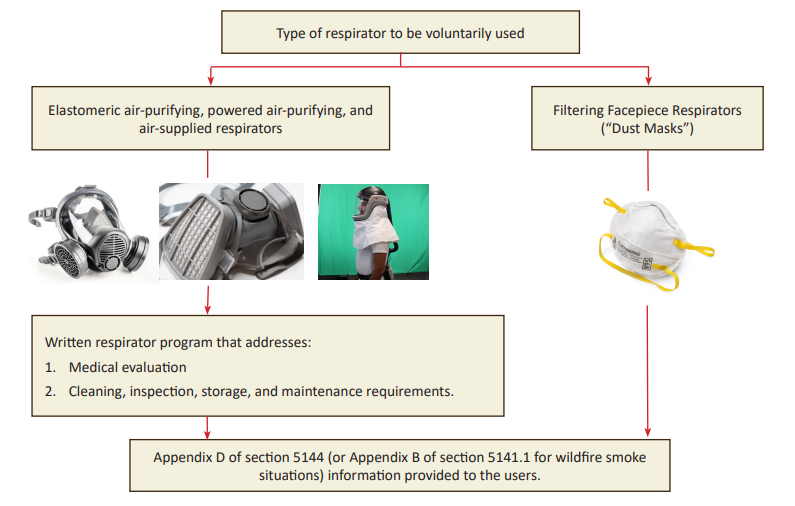 Source: Cal/OSHA, "Voluntary Use of Respirators" fact sheet (December 2024). Public domain.
Wildfire Smoke Considerations
Some jurisdictions — notably Cal/OSHA under section 5141.1 — have specific rules for wildfire smoke exposure. When the Air Quality Index (AQI) for PM2.5 exceeds certain thresholds, employers may be required to provide respirators for voluntary use and train employees on proper use, regardless of whether employees choose to wear them.
In wildfire smoke situations, employers must provide the information contained in Appendix B of section 5141.1 instead of (or in addition to) Appendix D.
The Bottom Line
Voluntary use doesn't mean unregulated use. If your employees are wearing respirators — even by choice — you have a responsibility to ensure they're doing so safely. The level of that responsibility depends on the respirator type, but Appendix D is always the starting point.
Not sure whether your program qualifies as voluntary use or requires a full respiratory protection program? We review and write your Written RPP at no charge as part of our testing service. Get a quote →